


Australian Laser Breakthrough: “This Changes Warfare Forever” As Drones Face Unstoppable Destruction From 2,500 Miles Away
 By
Noah Bennett
By
Noah Bennett
| IN A NUTSHELL |
|
The modern battlefield is evolving, with technological advancements reshaping military strategies worldwide. In this context, drones have emerged as a significant threat due to their cost-effectiveness and operational efficiency. In response, the Australian defense company Electro Optic Systems (EOS) has introduced a groundbreaking solution: the Apollo High Energy Laser Weapon (HELW). This innovative system can neutralize up to 200 medium-sized drones using its internal power supply, marking a significant leap forward in defense technology. By harnessing the power of lasers, EOS is setting new standards for counter-drone warfare, demonstrating the potential of high-energy lasers in modern military applications.
The Growing Drone Threat
Drones have become a fixture in military arsenals worldwide due to their versatility and efficiency. These unmanned aerial vehicles offer a low-cost platform for surveillance, reconnaissance, and attack missions. Their ability to operate in swarms adds another layer of complexity, making them a formidable challenge for traditional air defense systems. The increasing use of drones in conflicts underscores their potential to disrupt military operations and inflict significant damage with minimal risk to personnel.
The advantages of drones are manifold. They are small, making them difficult to detect and track with conventional radar systems. Additionally, their ability to fly at low altitudes allows them to evade many traditional defense mechanisms. Coupled with their relatively low production and operational costs, drones can be deployed in large numbers, overwhelming traditional air defenses and creating a significant tactical advantage.
In light of these challenges, there is an urgent need for effective countermeasures. High-energy lasers, which offer precision targeting and rapid engagement of multiple threats, are increasingly seen as a viable solution. These systems can neutralize drones at a fraction of the cost of traditional munitions, offering a sustainable and economical defense strategy.
The Apollo Laser Weapon
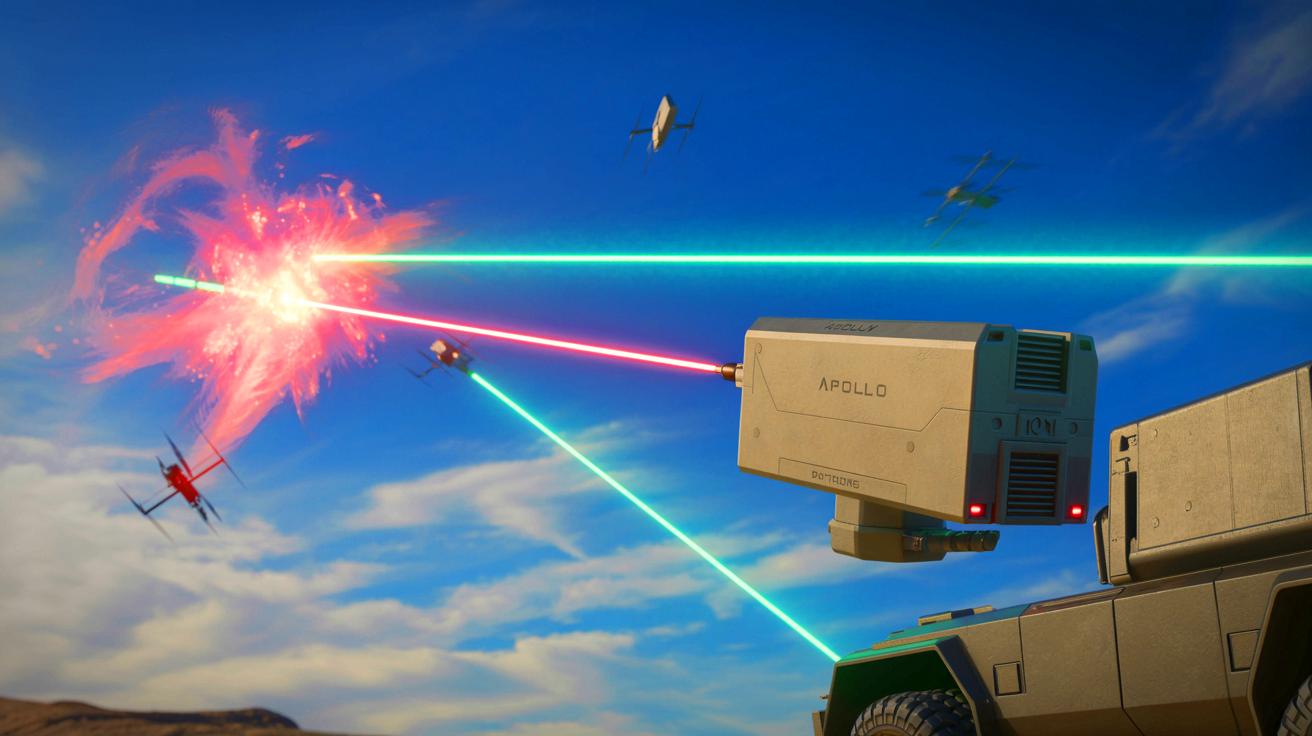
The Apollo High Energy Laser Weapon represents a significant advancement in laser technology. Developed by EOS, this system is designed to counter the specific challenges posed by drone swarms. With a power output that can reach up to 150 kW, the Apollo can engage and destroy drones at considerable distances, providing a robust defense against aerial threats.
The system’s design allows it to fit within a standard 20-ft shipping container, making it easily transportable and deployable in a variety of settings. Its dual emitter units can target and neutralize drones at ranges of up to 1.86 miles. Additionally, it can disable optical sensors from as far away as 9 miles, further enhancing its defensive capabilities.
In terms of operational efficiency, the Apollo can slew on target across 60° in only 700 milliseconds, enabling it to engage up to 20 Group 1 drones per minute. This rapid response capability is critical in scenarios involving drone swarms, where multiple targets must be neutralized quickly to prevent them from overwhelming defenses.
Operational Flexibility and Power Independence
One of the standout features of the Apollo system is its internal power supply. This capability ensures that the system remains operational even in the absence of an external power source. According to EOS, the Apollo can engage up to 200 drones before exhausting its internal power reserves. When connected to its primary power source, the system can operate indefinitely, provided the electronics remain functional.
This power independence adds a layer of operational flexibility, allowing the Apollo to be deployed in remote or contested environments where access to reliable power may be limited. The system’s ability to function as both a stand-alone weapon and as part of a layered defense system further enhances its adaptability, making it a versatile addition to any military arsenal.
Dr. Andreas Schwer, CEO of EOS Group, highlights the strategic importance of high-energy laser weapons: “There is strong international interest in high-energy laser weapons, and it is increasingly clear they will play a central role in counter-drone defense.” This statement underscores the growing recognition of lasers as a critical component in modern military strategies.
Cyclists Warn: “This Design Frustrates Us” as Shimano Launches New Cleat in the US
The Future of Counter-Drone Defense
The introduction of the Apollo High Energy Laser Weapon marks a significant step forward in the evolution of counter-drone technologies. As drones become increasingly prevalent on the battlefield, the need for effective countermeasures will continue to grow. High-energy lasers, with their precision, rapid response, and cost-effectiveness, are poised to play a central role in future military operations.
EOS’s commitment to developing ITAR-free solutions ensures that the Apollo system can be adopted, localized, and sustained by international partners without the constraints of export control regulations. This approach facilitates broader adoption and integration of the technology into various defense systems worldwide.
As the demand for high-energy laser weapons accelerates, the development of systems like the Apollo will be crucial in shaping the future of military defense strategies. The ability to effectively counter drone threats will be a decisive factor in maintaining air superiority and ensuring the safety of military operations in an increasingly complex and challenging environment.
The advancements in laser technology exemplified by the Apollo system highlight the ongoing evolution of military defense capabilities. As the landscape of modern warfare continues to change, the role of high-energy lasers in countering drone threats becomes ever more critical. How will military strategies adapt to integrate such technologies effectively, and what new challenges will arise as these systems become more prevalent? The answers to these questions will shape the future of conflict and security worldwide.
Continue reading