

Close Menu
  • Top Stories
  • News
  • Entertainment
  • Health
  • Home
  • Money
  • Sports
  • Tech
  • Transportation
  • Travel
  • About us
  • Advertising
  • Contact
Trending
How turboprops help reduce airport congestion
Illustration of the flu virus engaging in cellular invasion as observed through advanced ViViD-AFM microscopy.
Microscope Breakthrough Unveils Real-Time Flu Virus Invasion, Offering New Insights Into Disease Prevention and Control
Illustration of a microneedle-based sensor assessing fish freshness.
New Sensor Revolutionizes Fish Freshness Checks with Microneedles, Enhancing Safety and Trust in Seafood Consumption
Facebook X (Twitter) RSS
Fylladey
Facebook X (Twitter) RSS
  • Entertainment
  • Health
  • Home
  • Money
  • News
  • Sports
  • Tech
  • Top Stories
  • Transportation
  • Travel
Fylladey

“Shoreline Methane Bomb”: Scientists Discover Seaweed on Sandy Beaches Unleashes Dangerous Emissions That Threaten Our Coastal Ecosystems

A groundbreaking study from Monash University reveals that decomposing seaweed on sandy shores significantly contributes to methane emissions, challenging long-standing assumptions about coastal ecosystems and their role in climate change.
Noah BennettBy Noah Bennett09/06/202512
Share Twitter Facebook LinkedIn WhatsApp Email Copy Link
Follow Us
Google News
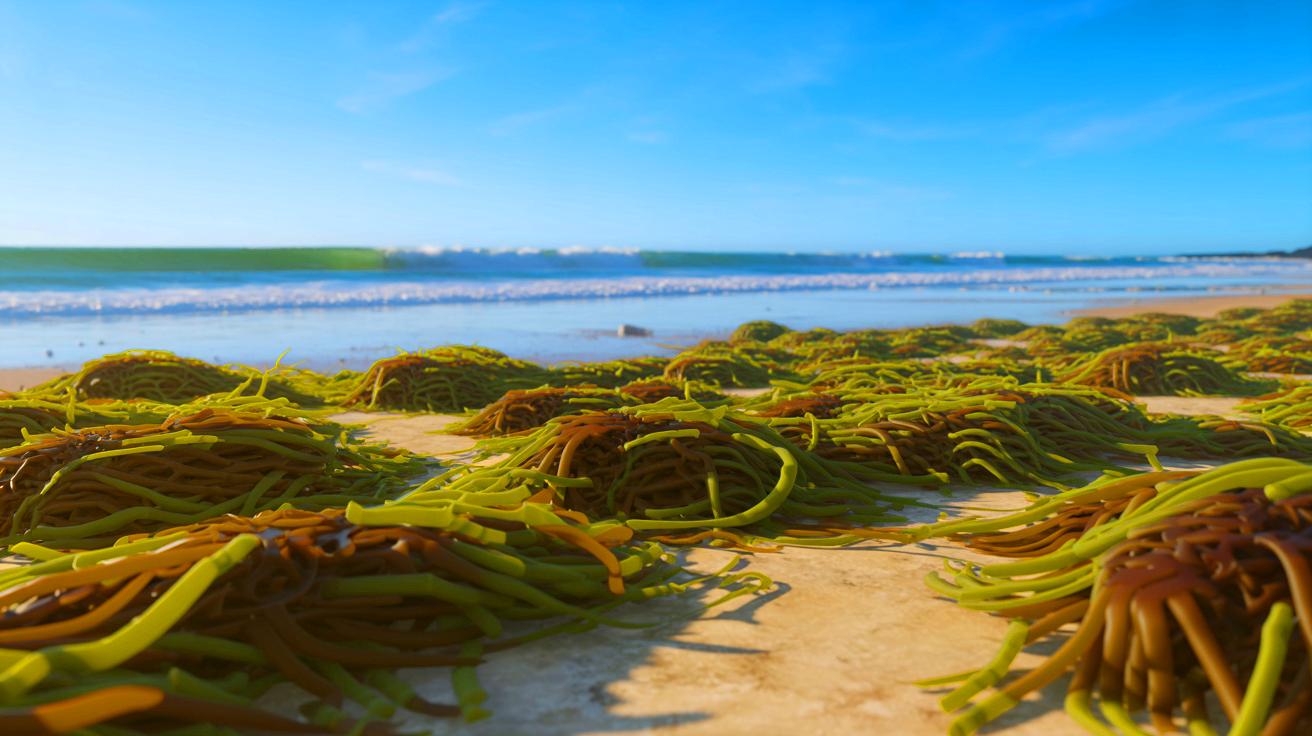
Illustration of decomposing seaweed on a sandy shore contributing to methane emissions.
Share
Twitter Facebook LinkedIn WhatsApp Email Copy Link
IN A NUTSHELL
  • 🌊 Decomposing seaweed on sandy shores significantly increases methane emissions, altering our understanding of coastal ecosystems.
  • 🔬 Methanogenic microbes thrive in these environments, producing high levels of methane even in the presence of oxygen.
  • 🌿 The study challenges “blue carbon” strategies by showing that seaweed breakdown may offset its climate benefits.
  • 📊 Future research aims to explore how different species and conditions affect methane production in coastal zones.

New research into coastal ecosystems has unveiled surprising contributors to greenhouse gas emissions. A recent study by Monash University has discovered that seaweed decomposing on sandy shores can significantly fuel methane emissions. This finding challenges long-held beliefs about the environmental impact of sandy coastlines and their role in climate change. Methane, a potent greenhouse gas, is typically associated with oxygen-free environments. However, this study reveals that the presence of seaweed may allow for methane production even in oxygenated settings, thus altering our understanding of coastal ecosystems’ contributions to greenhouse gas emissions.

Understanding Methane Emissions From Sandy Coasts

Traditionally, methanogenic archaea, the microorganisms responsible for producing methane, are known to thrive in environments devoid of oxygen, such as wetlands and rice paddies. However, the new study reveals that these microorganisms can survive and remain active even in sandy coastal regions where oxygen is present. This discovery was made by examining sandy coastlines in Victoria, Australia, and Avernakø, Denmark. Researchers found that seaweed washing ashore provides a source of organic matter that supports the growth of methanogenic microbes.

The study utilized a combination of satellite imagery and astronaut photographs to identify sandy coastlines, which make up approximately 31% of the world’s ice-free shores. Researchers collected water and sediment samples from specific sites in Australia and Denmark to measure methane concentrations. These concentrations were found to be significantly higher than expected, with some areas showing levels up to 1,900 times greater than what would normally be anticipated if the water were merely in equilibrium with the atmosphere.

The implications of these findings are significant. It suggests that sandy shorelines, previously overlooked in methane emission studies, play a more substantial role in greenhouse gas production than previously thought. This challenges the assumption that coastal ecosystems primarily act as carbon sinks, highlighting the complexity of their environmental impact.

As Senate Confirms CDC Director This “Shocking Resignation” of FDA Official Sparks Political Firestorm and Uncovers Deep Divisions in Health Policy

The Role of Methanogenic Microbes

The research identified that methanogenic microbes in coastal areas rely on methylated compounds released during the decomposition of seaweed and seagrass. This process leads to high rates of methane production, particularly in areas where seaweed debris accumulates. Unlike their counterparts in wetlands, these coastal methanogens can quickly resume methane production even after short exposure to oxygen, typically within one to two hours.

This rapid recovery contrasts with methanogens in other environments, which may take weeks to restart methane production after oxygen exposure. The study’s findings indicate that coastal methanogens are highly adaptable and capable of contributing significantly to methane emissions.

The research highlights that methane release rates from these coastal sites can match or even exceed those of recognized methane sources like wetlands and salt marshes.

Substack Faces Outrage as Critics Declare “This Platform Is a Breeding Ground for Hate” Despite a 10 Million Subscriber Base and Push Notification Apology

This adaptability raises concerns about the potential for increased methane emissions from coastal areas, particularly as climate change affects ocean temperatures and leads to more frequent algal blooms. As seaweed and seagrass accumulate on beaches, they create conditions conducive to methane production. This understanding necessitates a reevaluation of coastal management strategies to better account for these emissions.

Implications for Climate Change Strategies

The study’s findings have significant implications for climate change mitigation strategies, particularly those focused on “blue carbon” initiatives. These strategies often promote the use of seaweed and seagrasses as carbon sinks due to their ability to absorb carbon dioxide. However, the breakdown of these plants in sandy sediments may offset some of their climate benefits by releasing large amounts of methane.

Lead author Ning Hall emphasized the need for further research to understand the full scope of this process. By investigating how different species of seaweeds and varying ocean conditions influence methane production, researchers aim to improve predictions of greenhouse gas emissions from coastal zones. This knowledge is crucial for developing more accurate models of global methane emissions and refining strategies to mitigate their impact.

Feasts of the Past Show How Food Shapes Society: ‘What We Eat Defines Who We Are’ and Sparks Fierce Modern Debates on Cultural Identity

While the study has limitations, including its focus on specific sites and simplified laboratory experiments, it provides a crucial foundation for future research. Understanding the interactions between coastal ecosystems and greenhouse gas emissions is essential for developing effective climate policies.

Future Research and Environmental Impact

The groundbreaking research underscores the need for a deeper understanding of coastal ecosystems’ roles in greenhouse gas emissions. With climate change driving rising sea temperatures and increased nutrient pollution, the frequency of algal blooms and biomass accumulation on beaches is expected to rise. This could lead to more frequent and larger methane emissions from coastal areas, further contributing to global warming.

The study, funded by various research councils and conducted in collaboration with international partners, emphasizes the importance of continued investigation into this phenomenon. Researchers aim to explore how different environmental factors, such as species invasions and varying oceanic conditions, impact methane production in coastal zones.

The research published in Nature Geoscience offers a new perspective on the environmental impact of sandy coastlines. As we gain a better understanding of these ecosystems, the question remains: How can we effectively manage coastal areas to mitigate their impact on climate change while preserving their ecological value?

This article is based on verified sources and supported by editorial technologies.
Climate Change Research Coastal Ecosystems Sustainable Living
Follow on Google News Follow on X (Twitter)
Share. Twitter LinkedIn Facebook WhatsApp Email Copy Link
Previous ArticleThis Implant ‘Offers Hope’ for Transforming Corneal Blindness Treatment and Restoring Sight to Millions Worldwide
Next Article Laser Beams: General Atomics Achieves ‘Satellite Communication Breakthrough’ That Could Revolutionize Aerospace Connectivity by 2025
Noah Bennett
  • X (Twitter)

Noah Bennett, a Los Angeles-based journalist for Fylladey.com, reports on technology, online culture, and the environment. Trained at UBC’s School of Journalism, his stories capture how digital tools and media trends are reshaping everyday experiences. Contact: [email protected]

A lire également
Illustration of the Aguada Fénix archaeological site, highlighting its large-scale construction and cosmic alignment.

Aguada Fénix Discovery Reshapes Understanding of Early Maya Civilization, Revealing New Insights Into Ancient Societal Structures

Illustration of the OSIRIS-APEX spacecraft at asteroid Apophis.

“This Mission Survived Trump’s Cuts”: But Others Are Still Hanging in the Balance (and You May Be Affected)

Illustration of partisan language used in government communications during the shutdown.

Trump Admin Shatters Email Norms With Outrageous Auto-Reply That Terrifies Millions: Here’s What You Need To Know

Illustration of the Tiny Getaway with its unique upside-down living design and compact modern amenities.

This Tiny House Design Shatters Reality With Its Mind-Blowing Upside-Down Living Concept That Stuns Everyone

View 12 Comments
12 Comments
  1. sandranirvana on 09/06/2025 6:10 AM

    Wow, I had no idea seaweed could be such a problem! Are there any solutions for reducing these emissions? 🌿

    Reply
  2. bruce on 09/06/2025 6:10 AM

    Wow, I never thought seaweed could be such a big deal! 🌿

    Reply
  3. Zara on 09/06/2025 6:54 AM

    How much seaweed are we talking about here? Like a lot or just a little?

    Reply
  4. yusuf on 09/06/2025 7:11 AM

    Does this mean we should start cleaning up all the seaweed on beaches? 🤔

    Reply
  5. steven on 09/06/2025 7:36 AM

    Does this mean we should stop eating sushi? 🍣😂

    Reply
  6. Sophia on 09/06/2025 8:11 AM

    Great article—thanks for shedding light on this lesser-known issue! 👏

    Reply
  7. Malika_dancer on 09/06/2025 8:21 AM

    Great article! Thanks for shedding light on this important issue. 🙏

    Reply
  8. paulaequinox on 09/06/2025 9:04 AM

    I had no idea seaweed was contributing to methane emissions. Time for a beach cleanup!

    Reply
  9. Karim_sun on 09/06/2025 9:11 AM

    This is just another case of scientists trying to scare us. Seaweed has existed forever and never caused problems before. 😒

    Reply
  10. Khadija on 09/06/2025 9:47 AM

    Can this research be applied to other coastal areas beyond Australia and Denmark?

    Reply
  11. valerie on 09/06/2025 10:11 AM

    I wonder if this will affect the seafood industry, especially in coastal areas?

    Reply
  12. malika on 09/06/2025 10:32 AM

    Is there a difference in methane production between different types of seaweed?

    Reply
Leave A Reply Cancel Reply

Trending
How turboprops help reduce airport congestion
Illustration of the flu virus engaging in cellular invasion as observed through advanced ViViD-AFM microscopy.
Microscope Breakthrough Unveils Real-Time Flu Virus Invasion, Offering New Insights Into Disease Prevention and Control
Illustration of a microneedle-based sensor assessing fish freshness.
New Sensor Revolutionizes Fish Freshness Checks with Microneedles, Enhancing Safety and Trust in Seafood Consumption
News by category
  • Entertainment
  • Health
  • Home
  • Money
  • News
  • Sports
  • Tech
  • Top Stories
  • Transportation
  • Travel
Information
  • About us
  • Advertising
  • The editorial team
  • Contact
  • Legal Information
  • Privacy and Cookie Policy
About

Fylladey.com brings clarity to everyday complexity. Covering news, tech, health, finance, sports, travel, and more, the platform helps readers make sense of a fast-moving world. With insightful coverage and accessible content, it’s a daily guide to the topics that shape our lives, our choices, and our understanding of today.

Facebook X (Twitter)
Facebook X (Twitter) RSS
  • About us
  • Advertising
  • The editorial team
  • Contact
  • Legal Information
  • Privacy and Cookie Policy
© Fylladey.com. All rights reserved.

Type above and press Enter to search. Press Esc to cancel.