



“Robots Are Becoming Alarmingly Human”: This New ProTac Tech Sparks Fear Among Global Industries
 By
Gabriel Cruz
By
Gabriel Cruz
| IN A NUTSHELL |
|
Robots are increasingly becoming an integral part of our daily lives, from industrial operations to healthcare services. However, ensuring their safe and efficient operation around humans remains a challenge. The latest advancement, ProTac technology, offers a promising solution. Developed by a team at the Japan Advanced Institute of Science and Technology (JAIST), this innovation allows robots to sense both proximity and touch, enhancing their interaction with people. By employing cameras within their arms, robots can detect approaching individuals and adjust their movements accordingly. This development marks a significant step towards safer human-robot collaboration.
The Science Behind ProTac Technology
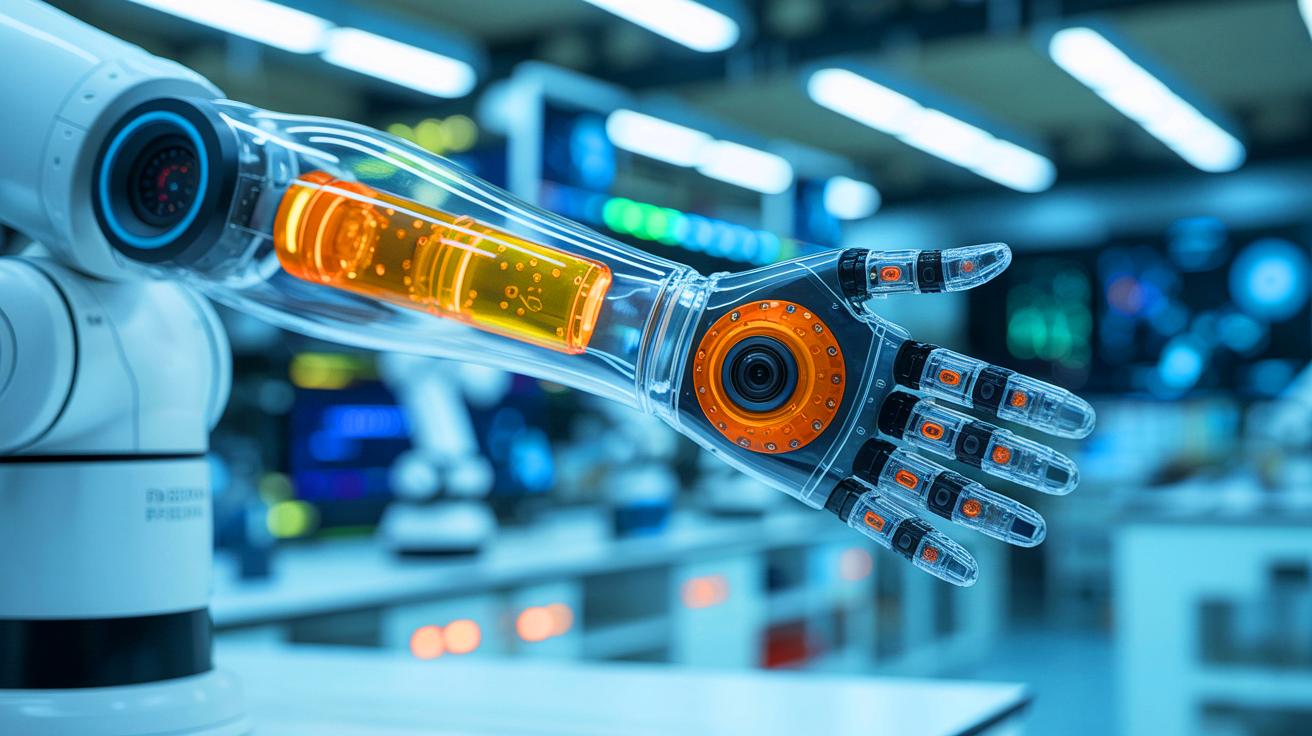
The ProTac system, designed by Prof. Van Anh Ho, Dr. Quan Khanh Luu, and their colleagues at JAIST, introduces a novel approach to robot-human interaction. It functions through an innovative integration of cameras and polymer-dispersed liquid crystal (PDLC) material. The key element of this technology is the ProTac link, a cylindrical robotic arm segment. This segment is enveloped in a soft, transparent polymer skin embedded with PDLC, allowing it to shift between transparent and opaque states with voltage application.
Inside the arm, stereoscopic cameras are positioned at each end. These cameras have the capability to peer through the transparent PDLC and observe the surroundings. The technology allows the robot to detect an approaching person, prompting it to either halt its movement or adjust its position to avoid contact. This ability to perceive proximity without physical contact is a breakthrough in robotic safety.
Innovative Touch Sensing Capabilities
When the PDLC becomes opaque, the cameras inside the ProTac link focus on an array of opaque dots set against a black background. The pressure applied on the robot’s flexible skin causes these dots to shift, allowing the cameras to detect touch. This mechanism provides the robot with detailed information on where and how much force is applied.
The tactile sensing feature of ProTac enables robots to perform tasks requiring delicate physical interaction, such as handling fragile objects or working in close proximity with humans. The system’s ability to rapidly switch between transparent and opaque states (known as “flicker mode”) enables simultaneous proximity and tactile sensing. This dual capability ensures precise monitoring and control during robot-human interactions, enhancing safety and efficiency.
Applications and Implications
ProTac technology holds significant potential across various domains requiring dexterous robotic manipulation. Industries such as healthcare, manufacturing, and service sectors can greatly benefit from this innovation. Robots equipped with ProTac can provide safer interactions in environments where human safety is paramount.
Dr. Luu emphasizes the value of ProTac in applications where both safety and delicate interaction are essential. By equipping robots with the ability to sense touch and proximity, the technology ensures that robots can handle tasks with the necessary care and precision.
“ProTac can be applied to dexterous robotic manipulation in various domains where safety and delicate physical interaction are critical,”
says Dr. Luu.
Future Prospects for Human-Robot Collaboration
The introduction of ProTac technology marks a significant evolution in the field of robotics. As robots become more integrated into human environments, the need for them to operate safely and effectively alongside humans becomes crucial. ProTac addresses this challenge by enhancing the sensory capabilities of robots, paving the way for more advanced human-robot collaboration.
Future research and development could expand the use of ProTac technology to other parts of a robot’s body, further enhancing its interaction capabilities. The potential for this technology to revolutionize industries reliant on close human-robot collaboration is immense. As robotics continues to evolve, how will ProTac and similar innovations shape the future of human-robot interaction?
Continue reading