


Close Menu
  • Top Stories
  • News
  • Entertainment
  • Health
  • Home
  • Money
  • Sports
  • Tech
  • Transportation
  • Travel
  • About us
  • Advertising
  • Contact
Trending
How turboprops help reduce airport congestion
Illustration of the flu virus engaging in cellular invasion as observed through advanced ViViD-AFM microscopy.
Microscope Breakthrough Unveils Real-Time Flu Virus Invasion, Offering New Insights Into Disease Prevention and Control
Illustration of a microneedle-based sensor assessing fish freshness.
New Sensor Revolutionizes Fish Freshness Checks with Microneedles, Enhancing Safety and Trust in Seafood Consumption
Facebook X (Twitter) RSS
Fylladey
Facebook X (Twitter) RSS
  • Entertainment
  • Health
  • Home
  • Money
  • News
  • Sports
  • Tech
  • Top Stories
  • Transportation
  • Travel
Fylladey

Aguada Fénix Discovery Reshapes Understanding of Early Maya Civilization, Revealing New Insights Into Ancient Societal Structures

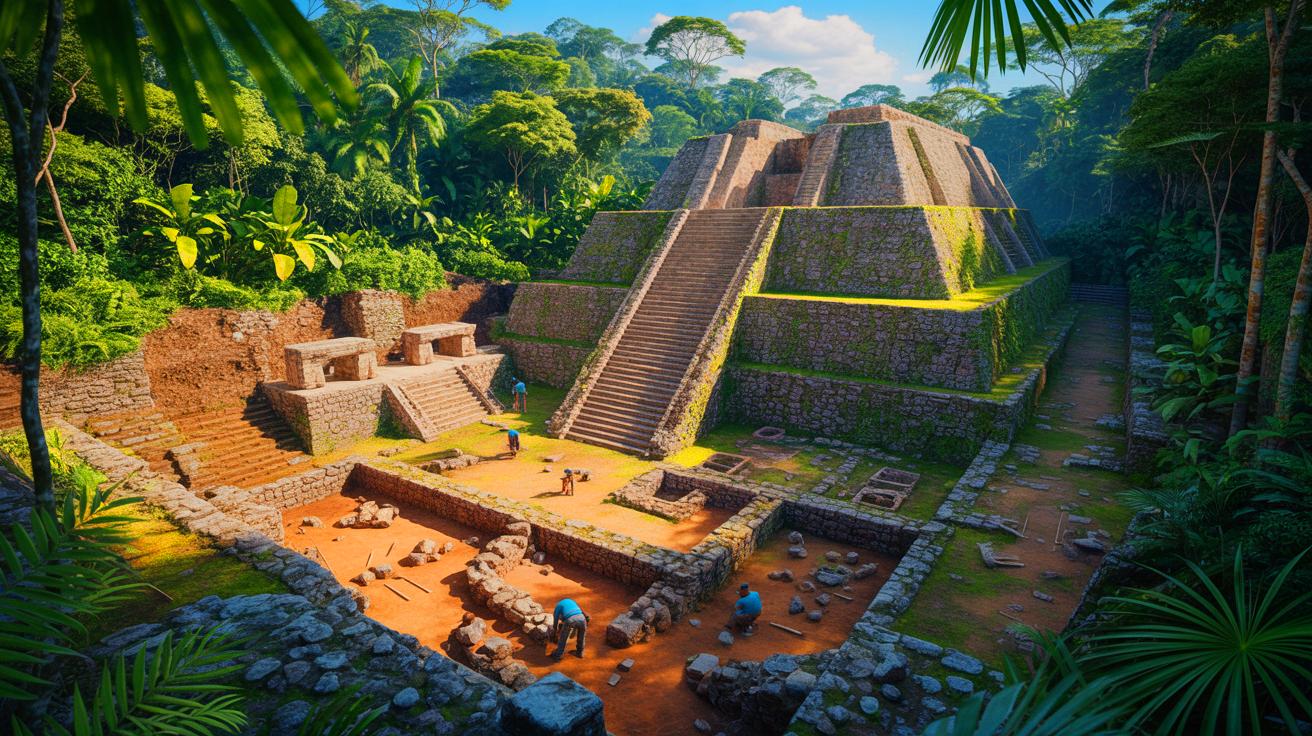
Archaeologists have uncovered Aguada Fénix, a monumental Maya site in Mexico, challenging traditional beliefs about early societal structures by demonstrating that large-scale construction was possible without centralized leadership.
Gabriel CruzBy Gabriel Cruz11/16/202512
Share Twitter Facebook LinkedIn WhatsApp Email Copy Link
Follow Us
Google News
Illustration of the Aguada Fénix archaeological site, highlighting its large-scale construction and cosmic alignment.
Share
Twitter Facebook LinkedIn WhatsApp Email Copy Link
IN A NUTSHELL
  • 🔍 Archaeologists discovered Aguada Fénix, a 3,000-year-old Maya site in Mexico, rewriting history.
  • 📏 The site is a cosmic map, aligning with the Maya sacred calendar and revealing astronomical insights.
  • 🔬 Excavations revealed ritual artifacts, such as jade axes, providing insights into early Maya spirituality.
  • 🗺️ Findings suggest large-scale construction was possible without centralized leadership, challenging traditional views.

The discovery of Aguada Fénix in Tabasco, Mexico, has challenged long-held beliefs about the development of early Maya civilization. This monumental site, dating back over 3,000 years, is reshaping our understanding of ancient societal structures. Unlike the hierarchical Olmec centers, Aguada Fénix suggests that large-scale construction was possible without centralized leadership. Instead, it appears that early Maya societies achieved remarkable feats through communal effort and spiritual significance. These revelations have sparked fresh discussions on how modern societies might organize collective endeavors without deep social divides.

Rethinking Early Maya Societal Structure

For decades, archaeologists believed that significant architectural achievements required centralized leadership. This assumption was based on the idea that only societies with strong hierarchies could organize and execute large construction projects. However, discoveries in the Maya region are challenging this narrative. Early Maya life was previously pictured as simple, with small-scale communities living in scattered villages. The emergence of big cities was thought to occur much later in history.

Yet, the uncovering of massive structures at sites like Ceibal and Xocnaceh began to question this view. The true paradigm shift occurred with the discovery of Aguada Fénix. Unlike its Olmec counterparts, this site showed no evidence of top-down power. Instead, it revealed a society capable of large-scale collaboration for construction projects. This new understanding is prompting scholars to reconsider how early Mesoamerican civilizations organized themselves.

Scientists Say “Dinosaur Breath Changed Our World” as Ancient Teeth Reveal Drastic Atmospheric Shifts Affecting Us All

Aguada Fénix as a Cosmic Map

A new study published in Science Advances suggests that Aguada Fénix was more than just a giant platform; it was a cosmogram, a symbolic map of the universe. Researchers found evidence that the site was designed with spiritual significance. This discovery implies that it may have been one of the most important spiritual places in the Maya world. The cosmic alignment of Aguada Fénix indicates a deep connection between the ancient Maya and their understanding of the universe.

Researchers discovered that the site’s center line aligns with the sunrise on specific dates, reflecting the 260-day sacred calendar used in Mesoamerican rituals. This alignment suggests that the builders of Aguada Fénix were not only architects but also astronomers. Their ability to carve a cosmic calendar into the land highlights the sophistication of early Maya culture. The implications of these findings extend beyond archaeology, offering insights into how societies can be organized around shared beliefs and communal goals.

Engineered Bacteria ‘Detect Hidden Threat’: Microplastics in Water Spark Urgent Global Alert—Can We Reverse the Damage?

Unearthing Ritual Significance

The excavation of Aguada Fénix revealed a cruciform pit filled with ceremonial treasures, including jade axes and ornaments. These artifacts provide rare insights into the sacred rituals of the early Maya. The presence of colored soils, arranged to align with the cardinal directions, underscores the ritual significance of the site. Blue, green, and yellow pigments were carefully placed to correspond with north, east, and south, respectively.

Researchers used radiocarbon dating and ceramic fragments to determine the age of these offerings. The findings suggest that early Maya builders placed these sacred items as part of a ritual, burying them under layers of sand and soil. The site likely served as a focal point for ceremonies and processions, attracting visitors who participated in renewing sacred bonds. This ritualistic aspect of Aguada Fénix highlights the importance of spiritual practices in early Maya society.

New Tarantula Genus Sparks Outrage: ‘These Spiders Are Invading Our Backyards and Threatening Our Kids’

Implications for Modern Society

The discoveries at Aguada Fénix challenge the notion that hierarchical structures are necessary for achieving large-scale projects. Takeshi Inomata, a leading archaeologist on the study, suggests that these findings have clear implications for modern society. The absence of royal command at Aguada Fénix indicates that shared purpose and communal effort can lead to remarkable achievements.

This perspective invites contemporary societies to reconsider the role of social inequality in achieving collective goals. The art and architecture of Aguada Fénix tell a story of community creation, as opposed to elite vision. The findings suggest that monumental achievements can emerge from collaboration rather than command. As modern societies face challenges requiring collective effort, the lessons from Aguada Fénix offer valuable insights into alternative forms of organization.

The discovery of Aguada Fénix has opened new avenues for understanding early Mesoamerican civilizations. This site, with its cosmic alignment and communal significance, stands as a testament to the power of shared purpose. As researchers continue to explore the implications of these findings, they raise important questions about how modern societies can harness communal effort to achieve significant goals. What can we learn from the ancient Maya about organizing large-scale endeavors in today’s world?


This article is based on verified sources and supported by editorial technologies.
Ancient Societal Structures Archaeological Discovery Maya Civilization
Follow on Google News Follow on X (Twitter)
Share. Twitter LinkedIn Facebook WhatsApp Email Copy Link
Previous ArticleDucati Unveils New Hypermotard V2 and SP: Lighter, More Powerful Models Set to Transform Riding Experience
Next Article Verge TS Pro Unveils Lighter Motor and Upgrades, Transforming the Electric Motorcycle Experience for Riders Everywhere
Gabriel Cruz
  • X (Twitter)

Gabriel Cruz has spent five years reporting for Fylladey.com, where he focuses on justice, policy, and international affairs. A graduate of City, University of London, he weaves together investigative work and global context to spotlight the issues behind the headlines. Contact: [email protected]

A lire également
Illustration of the OSIRIS-APEX spacecraft at asteroid Apophis.

“This Mission Survived Trump’s Cuts”: But Others Are Still Hanging in the Balance (and You May Be Affected)

Illustration of partisan language used in government communications during the shutdown.

Trump Admin Shatters Email Norms With Outrageous Auto-Reply That Terrifies Millions: Here’s What You Need To Know

Illustration of engineered bacteria detecting microplastics in water by glowing green.

Engineered Bacteria ‘Detect Hidden Threat’: Microplastics in Water Spark Urgent Global Alert—Can We Reverse the Damage?

Illustration of decomposing seaweed on a sandy shore contributing to methane emissions.

“Shoreline Methane Bomb”: Scientists Discover Seaweed on Sandy Beaches Unleashes Dangerous Emissions That Threaten Our Coastal Ecosystems

View 12 Comments
12 Comments
  1. julian on 11/16/2025 5:47 AM

    Wow, this discovery is mind-blowing! The Maya were way ahead of their time. 👏

    Reply
  2. isabella on 11/16/2025 5:48 AM

    Wow, this is groundbreaking! I always thought the Maya needed kings to build such amazing structures. 😮

    Reply
  3. samanthadolphin on 11/16/2025 6:34 AM

    Is there any evidence of similar sites elsewhere in Mesoamerica?

    Reply
  4. elisa on 11/16/2025 6:51 AM

    How did they determine the site was aligned with the sacred calendar? Is there any visual evidence?

    Reply
  5. abdul_harmony5 on 11/16/2025 7:19 AM

    Love how this challenges the idea that hierarchy is necessary for big projects. 💡

    Reply
  6. John_symphony on 11/16/2025 7:53 AM

    Thank you for the detailed explanation! It’s fascinating to see how ancient societies operated.

    Reply
  7. christineenergy on 11/16/2025 8:05 AM

    Wait, how did they manage to align everything with the sacred calendar? That’s insane!

    Reply
  8. Sophiaelixir on 11/16/2025 8:50 AM

    Are there plans to open Aguada Fénix to the public anytime soon?

    Reply
  9. Kamal on 11/16/2025 8:57 AM

    This discovery makes me wonder about how many other assumptions we have about ancient civilizations might be wrong.

    Reply
  10. Omar on 11/16/2025 9:34 AM

    This is fascinating! How do they know it was a communal effort, though?

    Reply
  11. Khadija on 11/16/2025 9:58 AM

    Can you provide more information on the specific artifacts found at the site? Were they unique to Aguada Fénix?

    Reply
  12. samanthatornado on 11/16/2025 10:21 AM

    Thank you for this enlightening article. Learned so much about the Maya!

    Reply
Leave A Reply Cancel Reply

Trending
How turboprops help reduce airport congestion
Illustration of the flu virus engaging in cellular invasion as observed through advanced ViViD-AFM microscopy.
Microscope Breakthrough Unveils Real-Time Flu Virus Invasion, Offering New Insights Into Disease Prevention and Control
Illustration of a microneedle-based sensor assessing fish freshness.
New Sensor Revolutionizes Fish Freshness Checks with Microneedles, Enhancing Safety and Trust in Seafood Consumption
News by category
  • Entertainment
  • Health
  • Home
  • Money
  • News
  • Sports
  • Tech
  • Top Stories
  • Transportation
  • Travel
Information
  • About us
  • Advertising
  • The editorial team
  • Contact
  • Legal Information
  • Privacy and Cookie Policy
About

Fylladey.com brings clarity to everyday complexity. Covering news, tech, health, finance, sports, travel, and more, the platform helps readers make sense of a fast-moving world. With insightful coverage and accessible content, it’s a daily guide to the topics that shape our lives, our choices, and our understanding of today.

Facebook X (Twitter)
Facebook X (Twitter) RSS
  • About us
  • Advertising
  • The editorial team
  • Contact
  • Legal Information
  • Privacy and Cookie Policy
© Fylladey.com. All rights reserved.

Type above and press Enter to search. Press Esc to cancel.