


AI-Powered Drones Using Lasers to Navigate Tiny Ducts Spark Debate: “Is This the Future of Surveillance or Just a Privacy Nightmare”
 By
Noah Bennett
By
Noah Bennett
| IN A NUTSHELL |
|
In recent years, the utilization of drones has expanded beyond traditional applications, venturing into areas such as infrastructure inspections and emergency response scenarios. A team of researchers from institutions including Inria, CNRS, and the University of Lorraine are pioneering efforts to enable drones to navigate the complex, confined spaces of ventilation ducts. This innovation draws inspiration from the iconic scenes of Bruce Willis navigating air shafts in the film “Die Hard,” yet it represents a significant leap forward in technology and capability. The goal is to create a reliable system that allows drones to maneuver through these challenging environments with precision and efficiency.
Challenges of Navigating Ventilation Ducts
Ventilation ducts present a unique set of challenges for drone navigation. These are typically small, enclosed spaces that are difficult to differentiate from one another, making navigation a complex task. The confined nature of these ducts means that drones can easily generate air currents that might inadvertently propel them into the walls, causing potential damage to both the drone and the infrastructure.
Researchers are focused on solving these issues by developing advanced technologies that can assist drones in navigating these environments. By simulating duct conditions, the team is investigating how drones can effectively traverse these spaces without collision. This requires overcoming the challenges posed by limited visibility and the lack of distinct navigational features within the ducts.
Ventilation ducts present a unique set of challenges for drone navigation.
Technological Innovations: AI and Laser Assistance
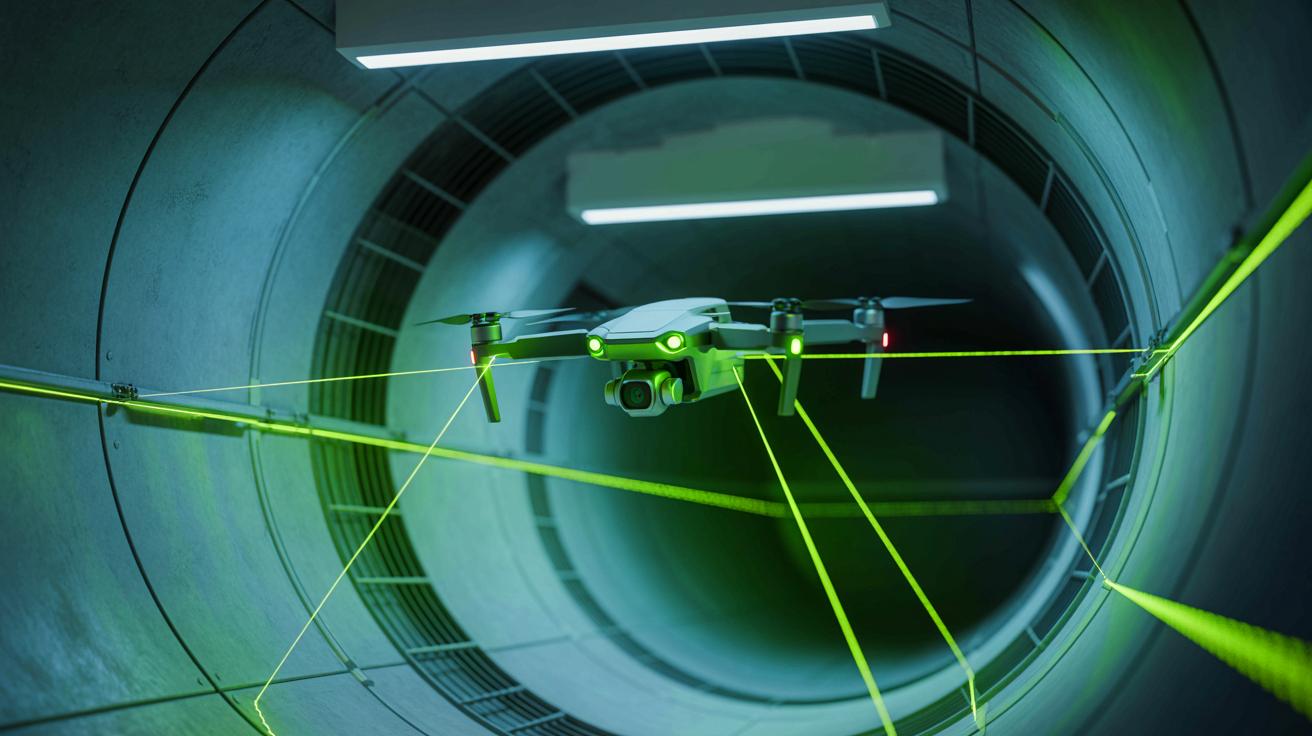
To address these challenges, the researchers have turned to cutting-edge technologies such as artificial intelligence (AI) and lasers. AI is being used to analyze and interpret data collected from the environment, allowing drones to make informed decisions about their movements. This involves real-time processing of data to understand the drone’s orientation and position within the duct.
In addition to AI, the use of lasers provides a means to map the environment and detect obstacles. Lasers can help create a detailed map of the duct, highlighting safe paths and potential hazards. The combination of these technologies aims to enhance the drone’s stability and navigation capabilities, reducing the risk of collision and improving overall performance in these confined spaces.
The combination of AI and lasers aims to enhance the drone’s stability and navigation capabilities.
Mapping Airflow for Improved Stability
A critical aspect of this research involves understanding the airflow within ventilation ducts. The team employs a robotic arm equipped with a force and torque sensor to measure air flow at various points inside a model duct. By mapping these air currents, researchers can identify unstable areas and safer zones where air currents cancel each other out.
This airflow mapping is crucial for improving the drone’s stability during flight. By identifying the areas with minimal air disturbance, drones can navigate more smoothly and avoid the erratic movements that can lead to crashes. This approach aims to create a robust system that allows drones to perform their tasks efficiently, even in the most challenging environments.
Future Prospects and Applications
The research team’s next objective is to construct a prototype drone capable of practical inspection tasks. This prototype will be equipped with cameras, thermal imagers, and gas sensors, enabling it to perform a variety of inspection and reconnaissance roles. These capabilities could prove invaluable in scenarios such as inspecting HVAC systems, conducting search and rescue missions, or gathering intelligence in hazardous environments.
By equipping drones with advanced sensors and imaging technology, researchers aim to extend their utility in both civilian and military contexts. The ability to navigate tight, featureless spaces with precision opens up new possibilities for how we approach inspections and emergency response operations. This innovation could revolutionize the way we utilize drones in complex environments, providing significant advantages in terms of safety and efficiency.
The advancements made by this research team signal a promising future for drone technology. As these systems are refined, their potential applications will continue to grow, offering new solutions to longstanding challenges in various industries. What other innovative uses for drones could emerge as we continue to explore their capabilities in challenging environments?
Continue reading