

Is This Revolutionary Teflon Recycling Method Truly “100% Efficient” or Just Another Eco-Friendly Pipe Dream?
 By
Noah Bennett
By
Noah Bennett
| IN A NUTSHELL |
|
The world of recycling is on the verge of a breakthrough that could transform how we deal with non-biodegradable waste. At the center of this innovation is Teflon, a material known for its non-stick properties and durability. Despite its widespread use, Teflon has long posed a challenge for recyclers due to its chemical inertness. Developed by Japan’s National Institutes for Quantum Science and Technology (QST), a new recycling technique promises to change this narrative with a 100% efficiency rate. This breakthrough not only addresses the environmental concerns but also opens the door to a more sustainable future.
The Accidental Invention of Teflon
Teflon’s journey from obscurity to ubiquity is a tale rooted in serendipity. In 1938, DuPont chemist Roy J. Plunkett stumbled upon this now-essential material while experimenting with tetrafluoroethylene (TFE) gas. His objective was to create a safer refrigerant that wouldn’t pose explosive or toxic hazards. In a twist of fate, Plunkett discovered a slippery white powder after a cylinder of TFE gas, stored on dry ice, appeared empty. This powder was none other than polytetrafluoroethylene (PTFE), later branded as Teflon.
Initially, the material’s unique properties posed a challenge. While it was chemically inert and nearly frictionless, Teflon was expensive to produce, and its potential applications were not immediately apparent. It wasn’t until the Manhattan Project required a material to handle corrosive uranium hexafluoride that Teflon found its first significant application. This marked the beginning of its ascent in various industrial sectors.
From Industrial Uses to Kitchen Staples
By the 1950s, Teflon had secured its place in industries ranging from electronics to engineering. Its potential seemed boundless, with applications in food processing, wire insulation, and even aircraft components. However, it was in the early 1960s that Teflon truly entered the public consciousness, thanks to the introduction of non-stick frying pans. These pans quickly gained popularity despite certain drawbacks, such as their susceptibility to scratches and the poor heat retention of the aluminum base.
Nevertheless, Teflon’s versatility and non-stick properties made it a household name. Its success story, however, came with a caveat: the very characteristics that made Teflon desirable also made it a recycling nightmare. The material’s resistance to degradation meant that most Teflon products ended up in landfills, contributing to the growing problem of non-biodegradable waste.
The Challenges of Recycling Teflon
Recycling Teflon is a complex and energy-intensive process. Traditional methods involve separating Teflon from its substrates, grinding, and subjecting it to high temperatures and chemicals. This makes recycling not only costly but also environmentally taxing, deterring many recycling programs from accepting Teflon-coated products.
Despite these challenges, the need for a sustainable solution has grown more urgent. With Teflon widely used across various industries, finding an efficient recycling method has become a priority for both environmentalists and manufacturers. The breakthrough by QST could be the answer to these longstanding issues, offering a more sustainable and cost-effective alternative.
Breaking New Ground with Electron Beam Technology
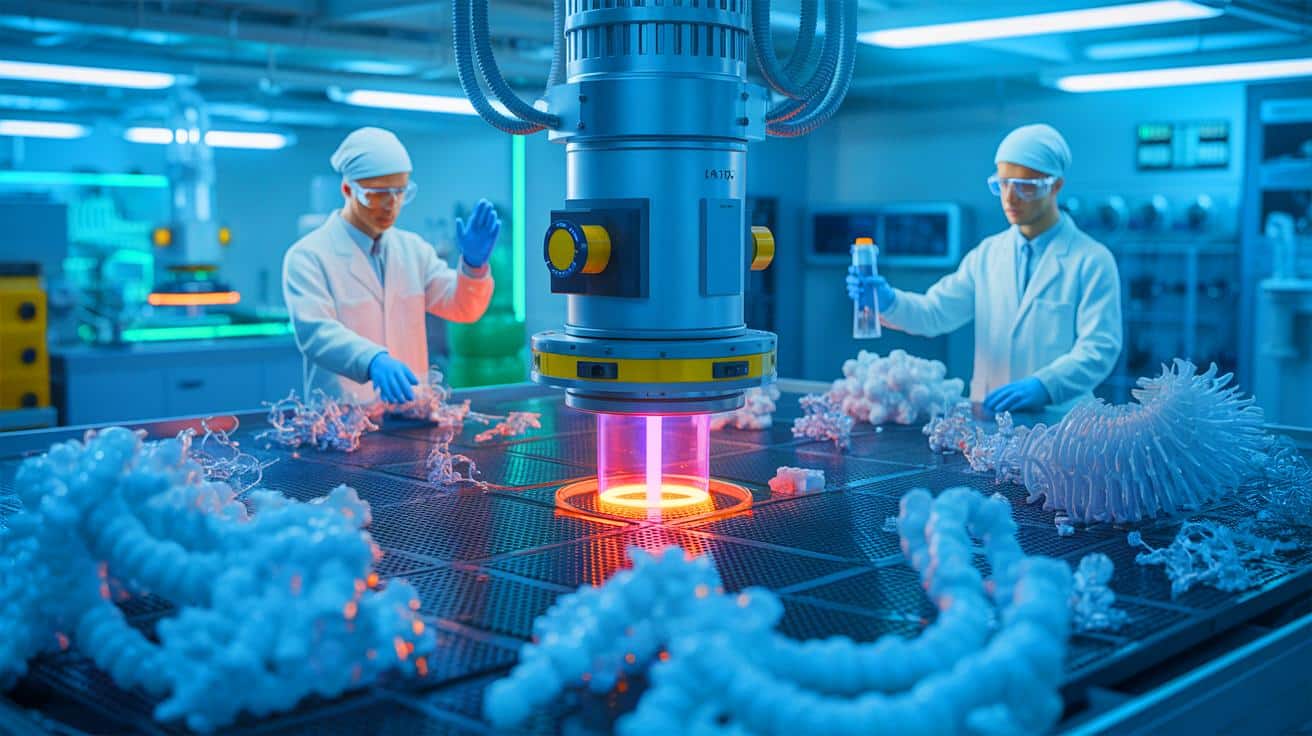
The innovative process developed by QST uses an electron beam to decompose Teflon at the molecular level. By heating Teflon in air to 698°F and then bombarding it with a 5-MGy electron beam, the polymer structure is altered, resulting in oxidized fluorocarbons and perfluorocarbons. These byproducts can be recycled into new products, achieving a 100% efficiency rate.
This method not only reduces energy consumption by half compared to traditional pyrolysis but also cuts atmospheric emissions significantly. Dr. Yasunari Maekawa, the research project leader, remarked, “We hope this technology will contribute to the safer, cleaner, and more cost-effective recycling of high-performance plastics.” The next step is to scale this process from the laboratory to industrial levels, a move that could revolutionize recycling practices worldwide.
The promise of a 100% efficient recycling method for Teflon marks a significant milestone in waste management and environmental conservation. As researchers work to refine and scale up this technology, the potential impact on industries and ecosystems is profound. Could this breakthrough be the start of a new era in recycling, where even the most challenging materials are given a second life?
Continue reading