


Close Menu
  • Top Stories
  • News
  • Entertainment
  • Health
  • Home
  • Money
  • Sports
  • Tech
  • Transportation
  • Travel
  • About us
  • Advertising
  • Contact
Trending
How turboprops help reduce airport congestion
Illustration of the flu virus engaging in cellular invasion as observed through advanced ViViD-AFM microscopy.
Microscope Breakthrough Unveils Real-Time Flu Virus Invasion, Offering New Insights Into Disease Prevention and Control
Illustration of a microneedle-based sensor assessing fish freshness.
New Sensor Revolutionizes Fish Freshness Checks with Microneedles, Enhancing Safety and Trust in Seafood Consumption
Facebook X (Twitter) RSS
Fylladey
Facebook X (Twitter) RSS
  • Entertainment
  • Health
  • Home
  • Money
  • News
  • Sports
  • Tech
  • Top Stories
  • Transportation
  • Travel
Fylladey

Outrage Erupts as Solar Mirrors Allegedly “Hunt Asteroids” at Night in Bold $50 Million Global Experiment

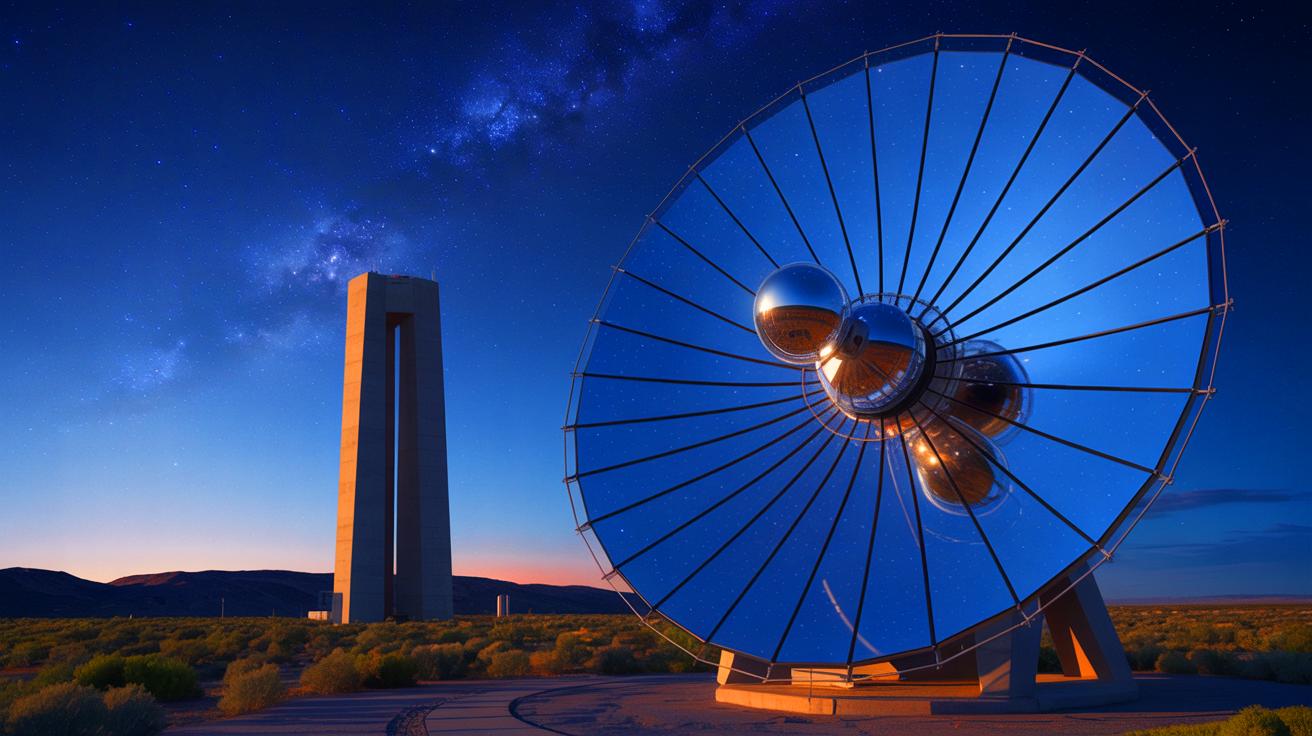
In a pioneering effort to expand the utility of solar power facilities, scientists at Sandia National Laboratories are transforming heliostat mirrors into nighttime asteroid detectors, potentially revolutionizing both space observation and solar technology applications.
Gabriel CruzBy Gabriel Cruz08/04/20258
Share Twitter Facebook LinkedIn WhatsApp Email Copy Link
Follow Us
Google News
Illustration of heliostat mirrors at Sandia National Laboratories being used for nighttime asteroid detection.
Share
Twitter Facebook LinkedIn WhatsApp Email Copy Link
IN A NUTSHELL
  • 🌌 Scientists at Sandia National Laboratories are repurposing heliostat mirrors for nighttime asteroid detection.
  • đź”­ The innovative technique uses heliostats to track the night sky, capturing frequency shifts to identify moving objects.
  • 🚀 This method could serve as a low-cost supplement to existing systems, with potential military applications for space monitoring.
  • 🔍 Researchers aim to scale up the technology to improve detection of near-Earth objects and enhance solar facility utility.

In a groundbreaking initiative, scientists at Sandia National Laboratories are pushing the boundaries of solar power technology by exploring its potential beyond daylight hours. Led by John Sandusky, this project seeks to utilize heliostat mirrors not just for solar energy capture, but also for nighttime asteroid detection. This innovative approach aims to address the limitation of solar power systems, which typically become inactive after sunset. By transforming solar facilities into dual-purpose tools, this research could enhance our ability to monitor asteroids, offering both scientific and potential military applications.

The Challenge of Solar Power Inactivity at Night

Solar power systems are inherently limited by their reliance on sunlight. Once the sun sets, these systems cease to generate power, leading to a complete shutdown until the next sunrise. This constraint has long been accepted as a technical and natural limitation. However, at Sandia National Laboratories’ National Solar Thermal Test Facility, researchers are questioning this status quo. They are exploring ways to harness solar infrastructure for productive purposes even when the stars are out.

The facility, unique in the United States, includes a 200-foot-high concrete tower surrounded by 218 mirrors on heliostats. These mirrors track the sun and concentrate its rays on a central tower to generate power. Despite producing 6 megawatts of thermal power during the day, the facility’s output drops to zero at night. This significant loss of potential has prompted researchers to seek alternative uses for the facility during these inactive hours.

“Witness the Future”: Humanoid Robot Adam Takes Center Stage at China’s Electrifying Music Festival, Shocking Thousands

Turning Heliostats Into Nighttime Telescopes

John Sandusky’s innovative approach involves repurposing heliostat mirrors for nighttime sky observation. By programming these mirrors to track the night sky like a telescope, Sandusky has managed to project reflected energy onto optical instruments atop the tower. Although this energy is minimal, it is sufficient for detecting asteroids under certain conditions.

Traditional asteroid detection relies on optical telescopes capturing time-lapse images of the sky. In these images, stars appear as points, while asteroids show up as streaks due to their motion. Sandusky’s method, however, does not produce visible images. Instead, it captures the photocurrent power spectrum of incoming light, detecting frequency shifts that indicate the presence of moving objects. This method, while less visually dramatic, holds promise as a cost-effective supplement to existing asteroid detection systems like NASA’s ATLAS.

Meet the $9,999 Game-Changing Humanoid Robot R1: Unitree’s Bold Move Sparks Outrage as Critics Say, “This Is the Beginning of the End for Human Jobs”

Potential Applications and Implications

The implications of Sandusky’s research extend beyond scientific curiosity. In addition to aiding asteroid detection, this technique could have military applications. By enabling defense agencies to monitor spacecraft operating secretly in cislunar space, it could enhance national security. However, achieving this would require further development to make the technique practical for such use.

Sandusky envisions scaling up the project from a single heliostat to multiple units. This expansion could significantly improve the detection of near-Earth objects, particularly smaller asteroids that are harder to spot. The potential to increase our understanding and monitoring of these objects could prove invaluable, especially given the dual nature of asteroids as both mineral resources and potential threats.

Hackers Exploit Bank Networks With 4G Raspberry Pi: “No System Is Safe” as They Target This $2 Trillion Industry and Endanger Millions

“We’re looking for opportunities to scale up from one heliostat to many and try to demonstrate that we can help find near-Earth objects,” said Sandusky.

Future Directions and Challenges

While the concept of using solar facilities for asteroid detection is promising, several challenges remain. Scaling up the project requires significant investment and technological development. The accuracy and reliability of the technique must be validated and refined before it can be adopted on a larger scale. Additionally, integrating this method with existing detection systems poses logistical and technical challenges.

Despite these hurdles, the research presented by Sandusky at the International Society for Optics and Photonics conference highlights the potential for innovation within the realm of solar technology. By reimagining the role of solar facilities, researchers are paving the way for multifaceted applications that could benefit both scientific exploration and security efforts.

As this research progresses, it raises important questions about the future of solar technology and its applications. How might further developments in this field reshape our approach to both energy generation and space observation? Could this dual-purpose use become a standard for solar facilities worldwide, transforming how we perceive and utilize solar energy infrastructure?

This article is based on verified sources and supported by editorial technologies.
Asteroid Detection Solar Technology Space Exploration
Follow on Google News Follow on X (Twitter)
Share. Twitter LinkedIn Facebook WhatsApp Email Copy Link
Previous ArticleIs This Revolutionary Teflon Recycling Method Truly “100% Efficient” or Just Another Eco-Friendly Pipe Dream?
Next Article Scientists Claim “Miracle Molecules” from Gut Bacteria Could Revolutionize Hormone Therapy and Transform Lives of Millions in the US
Gabriel Cruz
  • X (Twitter)

Gabriel Cruz has spent five years reporting for Fylladey.com, where he focuses on justice, policy, and international affairs. A graduate of City, University of London, he weaves together investigative work and global context to spotlight the issues behind the headlines. Contact: [email protected]

A lire également
Illustration of a microneedle-based sensor assessing fish freshness.

New Sensor Revolutionizes Fish Freshness Checks with Microneedles, Enhancing Safety and Trust in Seafood Consumption

Illustration of a biodegradable, stretchable battery developed by McGill University researchers for sustainable energy solutions.

Biodegradable Battery Innovation: Stretchy, Eco-Friendly Design Reshapes Future of Sustainable Technology and Environmental Impact

Illustration of the Tacray MT1 multitool with an integrated flashlight designed for practical everyday use.

“Unbelievable Power”: This Tiny Multitool Shines 260 Lumens to Light Your Way (and It’s Already in Your Pocket)

Illustration of the Outask TD2 lantern showcasing its multifunctional design with telescopic and magnetic features.

“This Changes Everything”: Telescoping Magnetic Multi-Lamp Reveals Hidden Potential (and It’s Already in Your Home)

View 8 Comments
8 Comments
  1. Florentpassion on 08/04/2025 5:47 AM

    Is this really feasible or just another pie in the sky idea? 🤔

    Reply
  2. malika on 08/04/2025 6:25 AM

    Wow, turning solar mirrors into asteroid hunters. Who would’ve thought? 🚀

    Reply
  3. john-lewis_origami on 08/04/2025 7:04 AM

    This sounds like a huge step forward! Thank you for the informative article!

    Reply
  4. Sylvester on 08/04/2025 7:42 AM

    How accurate are these heliostats in detecting asteroids compared to traditional methods?

    Reply
  5. kamal on 08/04/2025 8:20 AM

    What happens if the mirrors accidentally reflect sunlight at night? 🌕

    Reply
  6. Roland on 08/04/2025 8:58 AM

    Are there any environmental impacts to using heliostats this way?

    Reply
  7. Kamalstarlight on 08/04/2025 9:36 AM

    50 million dollars seems like a lot. Is this the best use of resources?

    Reply
  8. Eleanor on 08/04/2025 10:14 AM

    I’m skeptical. How will this affect existing solar energy production?

    Reply
Leave A Reply Cancel Reply

Trending
How turboprops help reduce airport congestion
Illustration of the flu virus engaging in cellular invasion as observed through advanced ViViD-AFM microscopy.
Microscope Breakthrough Unveils Real-Time Flu Virus Invasion, Offering New Insights Into Disease Prevention and Control
Illustration of a microneedle-based sensor assessing fish freshness.
New Sensor Revolutionizes Fish Freshness Checks with Microneedles, Enhancing Safety and Trust in Seafood Consumption
News by category
  • Entertainment
  • Health
  • Home
  • Money
  • News
  • Sports
  • Tech
  • Top Stories
  • Transportation
  • Travel
Information
  • About us
  • Advertising
  • The editorial team
  • Contact
  • Legal Information
  • Privacy and Cookie Policy
About

Fylladey.com brings clarity to everyday complexity. Covering news, tech, health, finance, sports, travel, and more, the platform helps readers make sense of a fast-moving world. With insightful coverage and accessible content, it’s a daily guide to the topics that shape our lives, our choices, and our understanding of today.

Facebook X (Twitter)
Facebook X (Twitter) RSS
  • About us
  • Advertising
  • The editorial team
  • Contact
  • Legal Information
  • Privacy and Cookie Policy
© Fylladey.com. All rights reserved.

Type above and press Enter to search. Press Esc to cancel.